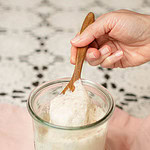
Beginner Sourdough Starter Recipe
This beginner sourdough starter recipe uses orange juice and bread flour to build a strong, reliable culture in 7 to 14 days. Includes day-by-day instructions, troubleshooting, and both a daily counter routine and my grandmother Nub's no-fuss thick refrigerator method.
Servings: 100 grams
Calories: 15kcal
Equipment
- Glass jar pint or quart size
- Kitchen scale
- Spoon or spatula non-metal preferred
- Rubber band or tape to mark the rise
Ingredients
- 400 grams unbleached bread flour divided across days 1 through 14
- 400 grams filtered or bottled water room temperature
- 50 grams fresh orange juice day 1 only
- 10 grams rye flour optional one-time boost on day 5 or 6 if activity is sluggish
Instructions
- Day 1, Mix and rest – In a clean jar stir together 50 grams fresh orange juice and 50 grams bread flour until smooth and thick. Scrape the sides clean, level the top, and mark the height with a rubber band. Cover loosely so air can move but dust stays out, then rest in a warm steady spot, 68 to 75°F, for 24 hours. What to expect: maybe a bubble or two and a mild citrus-grain smell. Quiet is completely normal on day one.
- Day 2, Observe, stir, rest – Look for small bubbles around the sides or on top. Give the mixture a quick stir to add oxygen, scrape the sides, and cover again. Let it rest warm for another 24 hours. What to expect: if nothing is happening that is perfectly fine. Fermentation often wakes up around days 3 to 4.
- Day 3, First regular feeding – Stir, then discard all but 30 grams of starter, saving the rest for discard recipes once it smells pleasant. Feed with 50 grams bread flour and 50 grams water. Mix smooth, scrape sides, mark the level, cover, and rest warm. What to expect: more bubbles through the day, maybe a gentle dome, then a soft collapse once it gets hungry again.
- Day 4, Repeat the rhythm – Discard all but 30 grams, feed with 50 grams bread flour and 50 grams water. Keep your temperature consistent and routine steady. What to expect: a slower rise today is normal as microbes rebalance. Stay the course and keep feeding.
- Day 5, Activity builds – Discard all but 30 grams, feed with 50 grams bread flour and 50 grams water. Mark the level and note the time fed. Start tracking how long it takes to rise and dome. Optional boost: if it still feels sluggish swap 10 to 15 grams of the bread flour for rye flour at this feeding, then return to 100% bread flour tomorrow. What to expect: more lift, a rounded dome, and a pleasantly tangy scent.
- Day 6, Stronger signs – Discard to 30 grams, then feed with 50 grams bread flour and 50 grams water. The mixture should have the texture of thick pancake batter. Add a splash of water if it is stiff or a spoonful of flour if it is thin. Keep the jar in a warm steady spot and stay consistent with your feedings. What to expect: more bubbles throughout, a light dome on top, and a clean mildly tangy scent. These are the first strong signs your starter is gaining strength.
- Day 7, Watching for readiness – Continue the same feeding routine and start timing how long it takes your starter to rise. A healthy balanced starter will double in volume within 4 to 6 hours of feeding, then slowly fall back down. That is your sign it is strong and ready to bake with. If you do not see a full double yet keep feeding once a day and stay patient. Depending on flour quality, kitchen temperature, and air conditions it may take up to day 14 to reach full strength. A faint nail polish smell simply means it is hungry. Feed it again and it will balance out.
Notes
Feed by weight – Always use a kitchen scale. A 1:2:2 ratio, starter, flour, water, keeps your starter consistent and balanced from feeding to feeding.
Warmth matters – Keep your starter between 68 to 75°F. The top of the fridge, a proofing box, or the oven with just the light on all work well.
Mark the jar – Use a rubber band or tape at the starting level after every feeding to track the rise accurately.
Keep it tidy – Scrape down the sides after stirring to prevent mold and make bubbles easier to see and track.
Be patient – Around days 3 to 4 most starters pause. Keep feeding daily, this is completely normal and part of the process.
Rye boost – If things feel sluggish on day 5 or 6, replace 10 grams of bread flour with rye for one feeding, then return to bread flour the next day.
Readiness signs – A strong starter will double in 4 to 6 hours after feeding, smell pleasantly tangy, and look web-like and airy when lifted with a spoon.
Storage – Once active and consistent, move to the refrigerator for the no-fuss method. Feed before chilling and it can rest up to 30 days between feedings.
Nutrition
Serving: 1g | Calories: 15kcal | Carbohydrates: 3g | Protein: 0.5g | Fat: 0.1g | Saturated Fat: 0.01g | Polyunsaturated Fat: 0.03g | Monounsaturated Fat: 0.01g | Sodium: 0.3mg | Potassium: 5mg | Fiber: 0.1g | Sugar: 0.1g | Vitamin A: 1IU | Vitamin C: 0.3mg | Calcium: 1mg | Iron: 0.04mg