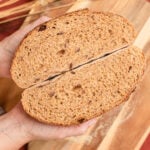
Cranberry Orange Sourdough Bread With Freshly Milled Flour
This fresh milled cranberry orange sourdough is made with 100% unsifted freshly milled hard red wheat, hard white wheat, and rye. Dried cranberries soaked in orange juice and the zest of two fresh oranges give this golden, crusty loaf a bright citrus flavor and soft whole grain crumb.
Servings: 16 slices
Calories: 34kcal
Equipment
- Dutch oven with lid
Ingredients
For the Cranberries
- 1 cup dried cranberries 120 grams
- Orange juice for soaking 50 grams
For the Flour
- Hard red wheat berries 225 grams
- Hard white wheat berries 225 grams
- Rye berries 50 grams
For the Dough
- ½ cup orange juice 118 grams total, including reserved cranberry-soaking juice
- 1 cup water 236 grams
- ½ cup active sourdough starter 100 grams
- 2 teaspoons sea salt 10 grams
- Zest of 2 oranges
Instructions
- Soak the cranberries – Combine 120 grams of dried cranberries with 50 grams of orange juice. Soak for at least 30 minutes or overnight. Drain, reserving the soaking juice, and gently pat the cranberries dry. Add enough fresh orange juice to the reserved juice to measure 118 grams total.
- Mill the flour – Mill 225 grams of hard red wheat berries, 225 grams of hard white wheat berries, and 50 grams of rye berries on your grain mill's finest setting. Use all the freshly milled flour without sifting.
- Mix and hydrate (autolyse) – Combine the freshly milled flour, 118 grams of orange juice, and 236 grams of water in the stand mixer bowl. Mix until no dry flour remains. Cover and rest for 30 to 45 minutes to allow the flour to hydrate.
- Add the starter and fermentolyse – Add 100 grams of active sourdough starter and mix until fully incorporated. Cover and rest for 20 to 30 minutes. This fermentolyse allows the flour, liquid, and starter to rest together before adding the salt.
- Add the salt – Add 10 grams of sea salt and mix until incorporated.
- Develop the gluten – Using the stand mixer fitted with a dough hook, knead for 8 to 12 minutes until the dough becomes smooth, elastic, and passes the windowpane test. Gently stretch a small piece of dough between your fingers. It should form a thin, translucent membrane without tearing immediately.
- Add the cranberries and orange zest – Once the gluten has developed, gently incorporate the orange zest from two oranges and the soaked, patted-dry cranberries. Mix by hand or on low mixer speed just until evenly distributed.
- Bulk ferment – Cover the dough and let it rise at room temperature. At approximately 74 to 75°F (23 to 24°C), my dough took about 4 hours to rise approximately 30 percent. Look for a gently domed surface and a slight jiggle when you move the bowl. Do not wait for it to double.
- Shape the loaf – Turn the dough onto a lightly floured work surface and shape directly into a tight boule. Place seam side up in a well-floured banneton basket. No separate bench rest is needed.
- Final proof – Cover the banneton and let the shaped dough proof at room temperature for approximately 1 to 2 hours, until noticeably puffy then transfer to the efrigerate, covered, for 8 to 16 hours for an overnight cold proof.
- *For a same-day bake, continue proofing at room temperature until the dough is properly risen. Because of the citrus, this may take longer, potentially up to 6-8 hours.
- Preheat the Dutch oven – Place the Dutch oven and lid inside the oven and preheat to 475°F (245°C) for 30 to 45 minutes. If using an oven-safe Instant Pot wire rack to help prevent a burned bottom crust, place it inside the Dutch oven.
- Score and bake – Carefully remove the hot Dutch oven and reduce the oven temperature to 450°F (230°C). Turn the chilled dough onto parchment paper, score the top, and carefully lower it into the Dutch oven. Cover and bake for 25 minutes.
- Finish baking – Remove the lid and reduce the oven temperature to 425°F (220°C). Continue baking for another 20 to 25 minutes, until the crust is deeply golden and the center reaches 205 to 210°F (96 to 99°C).
- Cool – Transfer the loaf to a wire cooling rack and cool for at least 1 hour before slicing.
Notes
Overnight cold proof – I recommend refrigerating the shaped loaf for 8 to 16 hours after its room-temperature proof. Bake directly from the refrigerator the next day.
Same-day option – A same-day bake is possible with active starter, but the final proof may take considerably longer because of the citrus. Allow the dough to become properly puffy before baking.
Sourdough discard – Discard may be used, but fermentation times will depend on its activity. Allow adequate room-temperature fermentation before the overnight cold proof.
Preventing a burned bottom – I use an Instant Pot wire rack in the bottom of my Dutch oven to help protect the bottom crust. Use only a rack suitable for the oven temperatures in this recipe.
Nutrition
Calories: 34kcal | Carbohydrates: 9g | Protein: 0.3g | Fat: 0.1g | Saturated Fat: 0.01g | Polyunsaturated Fat: 0.02g | Monounsaturated Fat: 0.02g | Sodium: 292mg | Potassium: 19mg | Fiber: 0.5g | Sugar: 6g | Vitamin A: 16IU | Vitamin C: 4mg | Calcium: 2mg | Iron: 0.05mg
