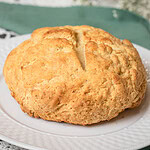
Traditional Irish Soda Bread Recipe
This traditional Irish soda bread recipe with buttermilk uses a blend of all-purpose and cake flour with cream of tartar for a golden crust and soft, tender crumb. For a rustic boule that slices beautifully warm.
Servings: 1 boule
Calories: 2445kcal
Equipment
- 1 Large mixing bowl
- 1 Whisk
- 1 Fork
- 1 Cast iron skillet
- 1 Sharp knife
- 1 Pastry brush
- 1 Wire rack
- 1 Instant read thermometer
Ingredients
- 3 cups all-purpose flour (spooned and leveled) 360 grams
- 1 cup cake flour 120 grams
- 2 tablespoons granulated sugar 25 grams
- 1½ teaspoons baking soda 7 grams
- 1½ teaspoons cream of tartar 5 grams
- 1½ teaspoons salt 9 grams
- 3 tablespoons salted butter (2 tablespoons softened for dough, 1 tablespoon melted for brushing ontop after baking) 42 grams
- 1½ cups buttermilk (full-fat) 360 grams
Instructions
- Heat the oven – Set it to 400°F and move the rack to the upper-middle position. This is where the crust builds that deep golden color without burning the bottom.
- Mix the dry ingredients – Whisk the all-purpose flour, cake flour, granulated sugar, baking soda, cream of tartar, and salt together in a large mixing bowl until evenly combined.
- Work in the butter – Drop in the 2 tablespoons of softened butter and work it in with a fork or your fingertips until the mixture looks like coarse, uneven crumbs. You want it to look a little shaggy, and if you can still see large chunks of butter, keep working it another minute.
- Add the buttermilk – Pour it in and stir with a fork until the dough pulls together into a shaggy mass. Stop the moment no dry flour remains, it looks rough and that's exactly right.
- Turn and knead gently – Turn the dough onto a lightly floured surface and knead 4 to 5 times until it holds together. Stop there, overworking it toughens the crumb.
- Shape the loaf – Pat the dough into a round about 6 inches across and 2 inches high. Keep the thickness even, that's what bakes the center and edges at the same rate.
- Score and set up – Set the loaf on a parchment-lined baking sheet or into a greased cast iron skillet. Cut a cross about ¼ inch deep across the top, running nearly to the edges.
- Bake and tent at 20 minutes – Bake at 400°F for 20 minutes. Tent loosely with foil, drop the oven to 375°F, and bake another 20 to 25 minutes until deep golden brown.
- Check for doneness – Push a skewer through the center, it should come out clean. Tap the bottom, it should sound hollow. Check the thermometer, it should read 190°F. All three together and you're done.
- Brush, rest, and serve – Brush the hot crust immediately with the remaining tablespoon of melted butter, move to a wire rack, and rest 30 to 40 minutes before slicing. Serve warm with salted butter alongside Irish stew, or toast thick slices the next morning with jam.
Video
Notes
Room temperature storage – Wrap the cooled loaf in a tea towel or beeswax wrap and store at room temperature for up to 2 days. Transfer to an airtight container for up to 3 days total.
Freeze for longer storage – Wrap the fully cooled loaf tightly in plastic wrap then foil and freeze for up to 2 months. Slice before freezing for individual portions.
Buttermilk substitute – Stir 1½ tablespoons of white vinegar or fresh lemon juice into 1½ cups of whole milk and let sit for 5 minutes until slightly curdled. Use in place of buttermilk.
Optional add-ins – Fold in ½ to ¾ cup raisins or currants, 1 to 2 tablespoons caraway seeds, or 1 to 2 tablespoons fresh orange zest into the dough before turning out onto the work surface.
Nutrition
Serving: 1g | Calories: 2445kcal | Carbohydrates: 421g | Protein: 66g | Fat: 52g | Saturated Fat: 29g | Polyunsaturated Fat: 4g | Monounsaturated Fat: 12g | Trans Fat: 1g | Cholesterol: 130mg | Sodium: 5790mg | Potassium: 1766mg | Fiber: 13g | Sugar: 43g | Vitamin A: 1646IU | Calcium: 502mg | Iron: 19mg