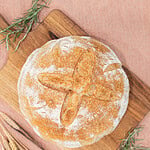
Rosemary Sourdough Bread
This rosemary sourdough bread is made with all-purpose flour, olive oil, honey, and fresh or dried rosemary, baked in a Dutch oven with a sourdough starter or discard. The crust bakes up deeply golden and crackly with an open, chewy crumb fragrant with rosemary throughout.
Servings: 1 Loaf
Calories: 2459kcal
Equipment
- 1 Large mixing bowl
- 1 dough whisk or wooden spoon
- 1 Bench scraper
- 1 banneton or medium bowl with tea towel
- 1 Dutch oven with lid 5 to 6 quart
- 1 razor blade or lame
- 1 Wire rack
Ingredients
- 1 ½ cups warm water 357 grams
- ½ cup active sourdough starter or sourdough discard 100 grams
- 4 cups unbleached all-purpose flour 500 grams
- 2 tablespoons honey 42 grams
- 3 tablespoons olive oil extra virgin, 40 grams
- 1 ½ teaspoons sea salt 9 grams
- ¼ teaspoon freshly ground black pepper 1.5 grams
- 2 teaspoons dried rosemary 2.4 grams, or 1 tablespoon fresh rosemary, finely chopped, 2 grams
- 1 teaspoon Italian seasoning 3 grams
- 4 to 8 cloves garlic minced, optional
- ⅛ teaspoon cayenne powder optional
Instructions
- Combine the dough – in a large bowl, whisk together 100g of active sourdough starter or 100g of sourdough discard, 357g of warm water, and 42g of honey until fully incorporated. Add 500g of unbleached all-purpose flour and mix with a dough whisk or wooden spoon until a shaggy dough forms with no dry patches. Cover with a tea towel and rest for 30 minutes to allow the flour to hydrate fully.
- Add the flavorings – after the rest, add 40g of olive oil, 9g of sea salt, 2 teaspoons of dried rosemary or 1 tablespoon of fresh rosemary finely chopped, 1 teaspoon of Italian seasoning, and 1/4 teaspoon of freshly ground black pepper. Add minced garlic and cayenne now if using. Fold everything into the dough using a dough scraper or wet hands until the additions are evenly distributed.
- Stretch and fold – perform 4 sets of stretch and folds, spaced 45 minutes apart. For each set, grab one side of the dough, stretch it up and fold it over the center, then rotate the bowl 90 degrees and repeat until all four sides are folded. Cover the bowl between sets. The dough will tighten and smooth with each set.
- Bulk ferment – after the final fold, cover the bowl with an airtight lid or plastic wrap and leave it at room temperature to ferment. With active starter, expect 6 to 12 hours. With discard, allow 12 to 24 hours. The dough is ready when it has risen 50 to 75 percent, the surface is domed and slightly jiggly, and bubbles are visible along the sides.
- Shape the loaf – turn the dough onto a lightly floured surface. Fold the edges toward the center to build surface tension, then flip the dough and use a bench scraper to drag it toward you in short strokes, tightening the boule. Let it rest uncovered on the counter for 20 minutes.
- Cold retard – transfer the shaped loaf into a floured banneton or a bowl lined with a floured tea towel, seam side up. Cover and refrigerate for 8 to 12 hours. This overnight rest deepens the flavor and firms the dough for a cleaner score.
- Preheat the oven – place your Dutch oven inside the oven and preheat to 435°F for at least 45 minutes. If using the cold Dutch oven method, skip preheating the Dutch oven.
- Score and bake – remove the dough from the refrigerator. Turn it out onto a piece of parchment paper and score the top with a razor blade at a 30 to 45 degree angle. Carefully lower the parchment and dough into the hot Dutch oven, replace the lid, and bake covered for 30 minutes. Remove the lid and bake for an additional 15 minutes until the crust is deeply golden and the internal temperature reads 205 to 210°F.
Video
Notes
Starter vs. discard – active starter produces a rise in 6 to 12 hours. Discard needs 12 to 24 hours for bulk fermentation. Both yield a full-flavored loaf.
Make-ahead – the shaped dough can cold retard in the refrigerator for up to 18 hours, giving you flexibility on bake day.
Flour substitution – for a freshly milled flour version, use hard white wheat milled fine and increase water by 10 to 15 grams. See Converting Recipes to Freshly Milled Flour for full guidance.
Troubleshooting a flat loaf – if the loaf spreads rather than rises, the starter or discard may not have been active enough, or bulk fermentation ran too long and the dough over-proofed. Look for a domed, jiggly surface before shaping.
Nutrition
Serving: 1g | Calories: 2459kcal | Carbohydrates: 446g | Protein: 56g | Fat: 47g | Saturated Fat: 7g | Polyunsaturated Fat: 7g | Monounsaturated Fat: 31g | Sodium: 3523mg | Potassium: 645mg | Fiber: 16g | Sugar: 36g | Vitamin A: 158IU | Vitamin C: 4mg | Calcium: 150mg | Iron: 25mg