Sourdough Cranberry Orange Bread Recipe
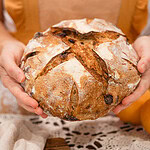
This cranberry orange sourdough bread bakes as a boule with tart dried cranberries, bright orange zest, and a crackly golden crust with a soft, open crumb that develops through a stretch-and-fold method and a long, slow fermentation.
Servings: 16 slices
Calories: 149kcal
Equipment
- Large mixing bowl
- Dutch oven with lid
- Banneton basket
Ingredients
- 1 cup dried cranberries 120 grams
- ½ cup orange juice for soaking cranberries, 50 grams
- ½ cup active sourdough starter or discard 100 grams
- 1¼ cups orange juice 245 grams
- ½ cup water 105 grams 2 teaspoons sea salt, 10 grams
- ⅓ cup rye flour 50 grams
- 3½ cups bread flour 450 grams
- Zest of 1 orange
Instructions
- Soak the cranberries – Pour 50 grams of orange juice over the dried cranberries in a small bowl and stir to coat. Let them rest for at least 30 minutes or overnight until soft and plump. Reserve any remaining soaking liquid to use as part of the 245 grams of orange juice in the dough.
- Mix the dough – In a large bowl, stir together the active sourdough starter or discard, bread flour, rye flour, 245 grams of orange juice, and water until a shaggy dough forms with no dry flour remaining. Cover with a damp towel and rest for 30 minutes to allow the flour to fully absorb the liquid.
- Add the flavor – Sprinkle the salt and orange zest over the rested dough, then drain the soaked cranberries and fold them in. Perform the first stretch and fold to incorporate everything evenly throughout the dough.
- Build strength – Over the next 2 to 3 hours perform three more stretch-and-folds spaced 45 minutes apart. Lightly dampen your hands before each round and fold the dough until it feels smooth, elastic, and noticeably stronger than the previous round.
- Shape the boule – After the final fold, shape the dough into a tight round ball and place it seam side up in a well-floured banneton basket. Cover and proof at room temperature for 4 to 5 hours, or cover tightly and refrigerate overnight for a cold ferment and next-day bake.
- Preheat the oven – When ready to bake, place a Dutch oven with its lid inside the oven and preheat to 450°F for at least 30 minutes. The Dutch oven must be fully heated before the dough goes in.
- Score and bake – Turn the dough onto a sheet of parchment paper and score the top with a sharp knife or lame. Carefully lower the dough into the hot Dutch oven using the parchment, drop in 2 ice cubes for steam, and cover with the lid. Bake covered for 30 minutes.
- Finish the crust – Remove the lid and bake for another 15 minutes until the crust is deep golden and the loaf sounds hollow when tapped on the bottom. The internal temperature should read 205 to 210°F on an instant-read thermometer.
- Cool and slice – Transfer the loaf to a wire rack and cool for at least one hour before slicing. Slicing too early releases steam still finishing the crumb and produces a gummy texture rather than a clean, tender slice.
Notes
Reserve the soaking liquid – Once the cranberries have soaked, pour off any remaining juice and use it as part of the 245 grams of orange juice in the dough. It carries extra cranberry and citrus flavor into the crumb.
Dampen your hands for stretch and folds – Lightly wet hands before each round to prevent the dough from sticking. Lift one side, stretch it upward, and fold it over itself, then turn the bowl and repeat until the dough feels smooth and elastic.
Check doneness with a thermometer – The crust color and hollow tap are reliable cues but an internal temperature of 205 to 210°F on an instant-read thermometer confirms the loaf is fully baked through to the center.
Cool completely before slicing – At least one hour on a wire rack allows the steam inside the loaf to finish setting the crumb. Slicing too early produces a gummy, dense texture rather than a clean, tender slice.
Nutrition
Calories: 149kcal | Carbohydrates: 32g | Protein: 4g | Fat: 1g | Saturated Fat: 0.1g | Polyunsaturated Fat: 0.2g | Monounsaturated Fat: 0.1g | Sodium: 2mg | Potassium: 93mg | Fiber: 1g | Sugar: 8g | Vitamin A: 55IU | Vitamin C: 14mg | Calcium: 8mg | Iron: 0.4mg